




Generative AI Performance Report in Google Search Console
Google Search is changing, and Search Console is starting to change with it.
In June 2026, Google introduced a new Generative AI performance report in Google Search Console, giving website owners a dedicated view of how their sites appear in generative AI features on Google Search. The report currently covers AI Overviews and AI Mode, and Google is rolling it out gradually to a subset of websites.
For businesses investing in SEO, this is useful news.
AI search visibility has been difficult to measure. You might see your website appear in an AI Overview or AI Mode response, but that single observation doesn’t tell you how often your pages are appearing or whether that visibility is changing.
The new report starts to answer those questions.
What is the Generative AI performance report in Google Search Console?
The Generative AI performance report is a new Search Console report designed specifically to show your site’s visibility in Google’s generative AI search features.
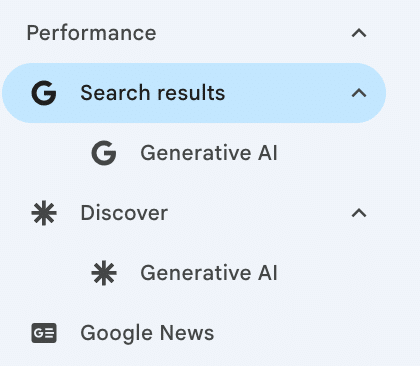
Google launched it alongside a separate generative AI report for Discover. The Search report focuses on generative AI features within Google Search, currently including AI Overviews and AI Mode.
The data isn’t completely separate from your existing Search performance data. Google says generative AI traffic continues to be included in the overall Performance report, while the new report provides a dedicated view of that AI-related visibility.
In other words, you don’t have a completely new version of SEO happening inside Search Console.
You have another way to look at how people are discovering your website through Google.
What does the report actually show?
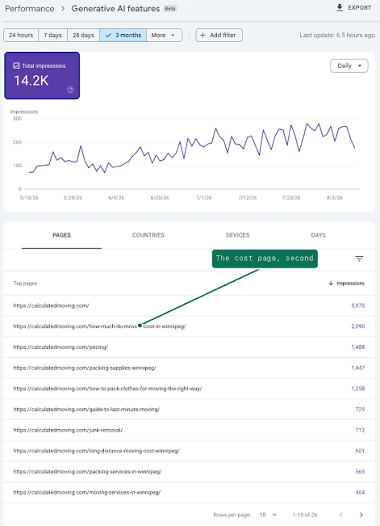
The report is focused primarily on impressions from generative AI features.
Google defines an impression here as a time when a link to your site was shown to a user within a supported generative AI feature on Google Search.
You can break the data down using several dimensions, including:
- Pages, so you can see which URLs are receiving visibility
- Countries, showing where searches originated
- Devices, including mobile, desktop and tablet
- Dates, allowing you to look at changes over time
You can also change the date range and export the report data for further analysis.
This makes the report more useful than simply searching for your own business and checking whether an AI answer appears.
Does it include AI Overviews and AI Mode?
The report is focused primarily on impressions from generative AI features.
Google defines an impression here as a time when a link to your site was shown to a user within a supported generative AI feature on Google Search.
You can break the data down using several dimensions, including:
- Pages, so you can see which URLs are receiving visibility
- Countries, showing where searches originated
- Devices, including mobile, desktop and tablet
- Dates, allowing you to look at changes over time
You can also change the date range and export the report data for further analysis.
This makes the report more useful than simply searching for your own business and checking whether an AI answer appears.
Yes.
At the moment, the Search report includes impressions from AI Overviews and AI Mode. Google says the list of supported generative AI features may expand as Search develops.
AI Overviews provide an AI-generated summary in Search, with links to supporting web sources. AI Mode takes this further with a more conversational search experience, allowing users to ask follow-up questions and explore a topic through multiple searches.
That makes Google’s approach to AI Mode and SEO particularly relevant for businesses thinking about where their organic visibility is heading.
There is one important limitation: Search Console does not include data from experiments in Search Labs.
What the report does not tell you
This is where it’s worth keeping expectations realistic.
The new report is not an AI ranking score.
It doesn’t give you a complete list of every prompt where your business appeared.
It doesn’t tell you every time an AI system mentioned your brand.
And it doesn’t measure your visibility across every AI platform.
The report is specifically about Google’s generative AI features in Google Search.
That’s an important distinction.
There is a lot of discussion around “GEO” and AI optimisation, but seeing impressions in this report doesn’t mean Google has introduced a new GEO ranking factor.
Instead, Google is giving website owners more visibility into an existing part of Search.
That makes the data useful, but it shouldn’t be treated as a magic score showing whether your website is “optimised for AI”.
Why does AI search visibility matter?
Traditional SEO reporting has usually focused on familiar questions.
How many people searched for something?
How many saw your page?
How many clicked?
Which queries brought them to your website?
AI search adds another layer.
A user can now search for something and receive an AI-generated response containing links to supporting websites before they ever work through a traditional list of results.
That means businesses need to understand more than where they rank for a keyword.
They also need to understand whether their content is useful enough to appear in the AI experiences surrounding those searches.
That starts with the basics.
Useful information.
Clear pages.
Strong internal linking.
Good technical SEO.
And content that actually answers the questions customers are asking.
We’ve covered more about building content AI actually understands and why the way you structure information matters as search becomes more conversational.
How can you improve your visibility in Google's AI search features?

There isn’t a secret switch for this.
Google’s guidance is refreshingly straightforward: continue focusing on the fundamentals of good SEO and create unique, valuable, people-first content.
That means starting with the questions your customers genuinely need answered.
Don’t create an article because an SEO tool suggested a keyword.
Create it because someone is likely to search for that information.
Make the answer clear.
Explain things properly.
Show experience where relevant.
Keep important information about your business accurate and easy to find.
And make sure your website is technically sound.
The same applies when thinking about how your business is represented across AI platforms. Understanding how to get your business recommended by ChatGPT can help put AI discovery into a wider context.
The fundamentals haven’t suddenly disappeared because AI has arrived.
If anything, they matter more.
What should you do with the new data?
Don’t open the report once, see a number and forget about it.
Look for patterns.
Which pages are receiving the most AI impressions?
Which topics seem to be generating visibility?
Are particular pages becoming more visible over time?
Are there important pages receiving very little exposure?
Are there differences between countries or devices?
The answers can help you decide where to improve your content rather than relying entirely on guesswork.
For example, if one useful guide is consistently appearing in AI Search while another page covering a similar topic isn’t, it may be worth looking at the difference between them.
The goal isn’t simply to increase a number.
It’s to understand what Google is finding useful enough to surface and use that information to make better decisions about your website.
AI Search visibility is becoming easier to measure
The new Generative AI performance report doesn’t answer every question about AI search.
It doesn’t show everything happening across the growing number of AI platforms.
But it does give website owners something valuable: first-party Google data about visibility in Google’s own generative AI search features.
And that’s a meaningful step forward.
For businesses, the conversation can now move beyond “Should we optimise for AI?”
A better question is:
What is actually happening to our visibility in AI Search, and what can the data tell us?
If you’re already investing in SEO, this is another report worth keeping an eye on.
Google is still rolling the feature out, so don’t worry if you can’t see it in Search Console yet. Not every website has access, and Google says a site may also lack the report if it hasn’t received enough impressions from generative AI features.
Frequently Asked Questions
The Generative AI performance report is a new Google Search Console report that shows how your website performs in Google’s generative AI search features. It currently includes data from AI Overviews and AI Mode.
Yes. The new Generative AI performance report includes visibility from AI Overviews. Website owners can use the report to see impressions and understand which pages are appearing in Google’s AI-generated search experiences.
Yes. Google includes AI Mode in its Generative AI performance reporting. This allows website owners to monitor how their pages are appearing in this newer conversational search experience.
The report provides performance data such as impressions, along with dimensions including pages, countries, devices and dates. This can help businesses understand where their AI search visibility is coming from.
Not currently. The Generative AI performance report does not provide a complete list of every prompt where your website appeared or every time an AI system mentioned your business. It is primarily a visibility and performance report for Google’s generative AI search features.
No. Google has not introduced a separate AI ranking score or GEO score in Search Console. The report provides additional visibility into performance within Google’s generative AI features rather than replacing traditional SEO rankings.
Start with the same strong SEO foundations that help users and search engines understand your website. Create useful, original content, answer relevant customer questions, maintain good technical SEO, use clear internal linking and keep important information accurate and up to date. Google’s guidance recommends focusing on helpful, people-first content rather than trying to create shortcuts specifically for AI Search.