ChatGPT Ads for B2B Companies: How to Reach Decision Makers
ChatGPT Ads for B2B companies can help brands reach decision makers during early research stages. Learn how they work, benefits, and strategy insights.

By Maximus Mediascape
TLDR
Learn how to get your business recommended by ChatGPT using trust signals, reviews, authority content, and AI search visibility strategies.
Ask AI to summarise
People are no longer just searching for websites; they are asking for recommendations. Instead of typing “best ISO audit software” into Google and scrolling through ten blue links, they are asking ChatGPT: “What is the best ISO audit software for a manufacturing company?”
The businesses that appear in those answers are not there by accident. If you want to stay visible as search behaviour shifts, you need to understand how to get your business recommended by ChatGPT.
But the real question isn’t “how do I get mentioned?” The real question is: why would ChatGPT trust your business enough to recommend it in the first place?
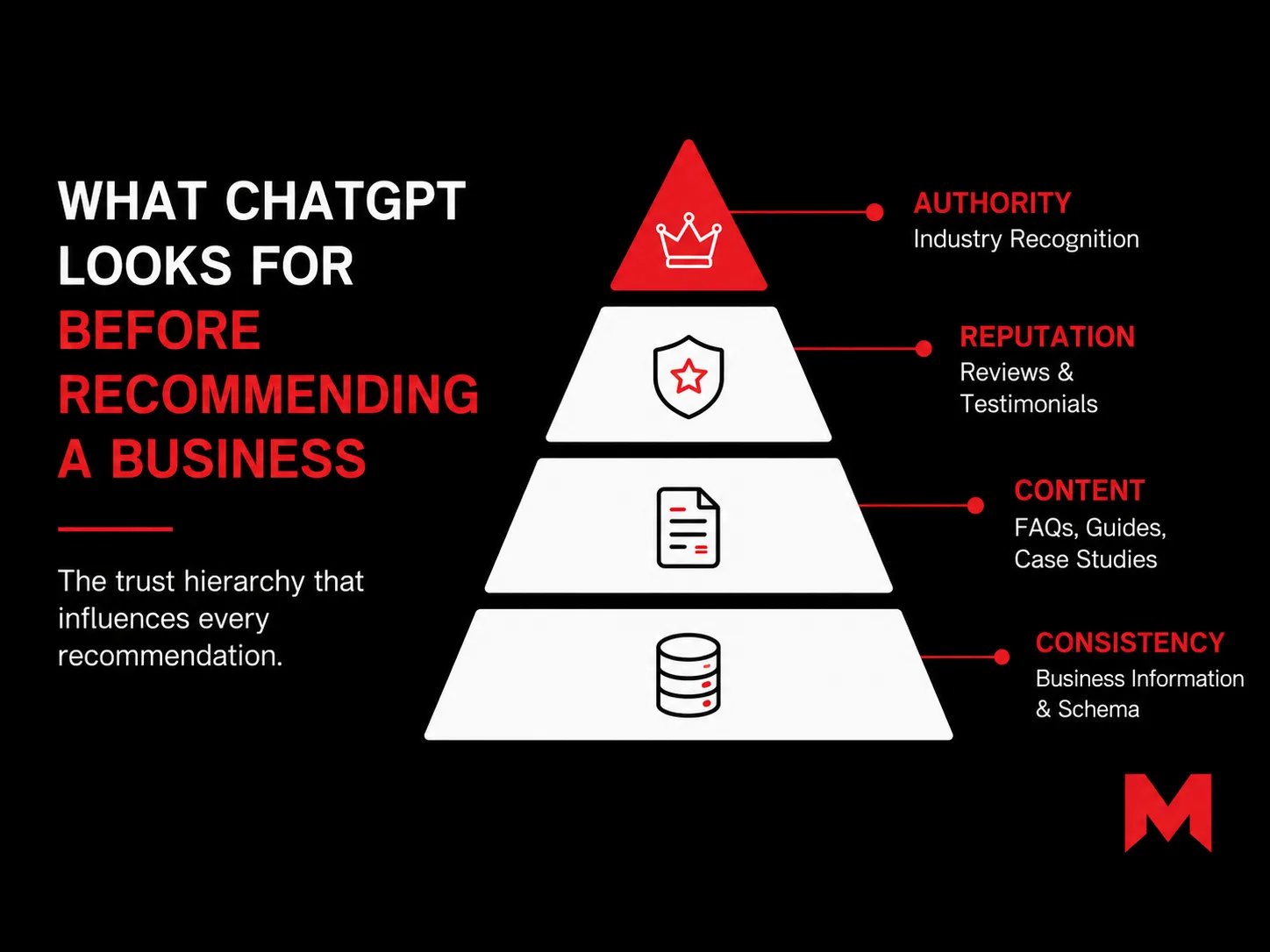
ChatGPT is not searching for companies that want visibility. It is searching for companies that already have credibility signals across the web.
Traditional SEO asks: Which page should rank for this keyword?
AI search asks: Which company is the most trustworthy answer to this specific problem?
This is a fundamental shift from keyword-based search to entity-based search. To an AI, your business is an “entity.” If ChatGPT sees that your website says you are the best, it doesn’t take that as fact. That is just a claim. But if it sees industry publications mentioning you, customers reviewing you on third-party sites, and people discussing your brand on platforms like Reddit or Quora, it sees independent validation.
To understand how to get your business recommended by ChatGPT, you have to look at the “digital footprint” your brand leaves outside of its own website. AI models synthesise data from the entire web to determine authority.
| Signal | Why It Matters for AI Recommendations |
|---|---|
| Third-Party Reviews | Independent proof of quality from Google, Trustpilot, or industry review platforms. |
| Industry Mentions | Validation from authoritative blogs, news sites, and trade associations. |
| Structured Content | Schema markup and technical data that make business details easy to verify. |
| Community Discussions | Real-world mentions on Reddit, Quora, and niche professional forums. |
| Case Studies | Evidence showing successful outcomes for real clients and projects. |
| Consistent Data | Identical business information across directories, websites, and listings. |
Most companies focus almost entirely on their own “owned” media: their website, their service pages, and their social media profiles.
If ChatGPT sees that your website says you’re an expert, but finds no mention of you anywhere else, its “confidence score” in your brand remains low. AI recommendations are heavily influenced by what exists outside your website.
For example, if a client like iAudit wants to be recommended for “ISO 9001 internal audit software,” publishing one landing page is not enough. The web needs multiple signals connecting the brand to that topic. This includes SEO-optimised blog content, technical whitepapers, industry directory listings, and expert contributions to external sites. Over time, the brand becomes synonymous with the subject matter.
AI systems prefer content that is easy to extract and understand. Vague marketing copy and corporate buzzwords are “noise” to an AI. To improve your chances, your website design and development should prioritise clarity and structure.
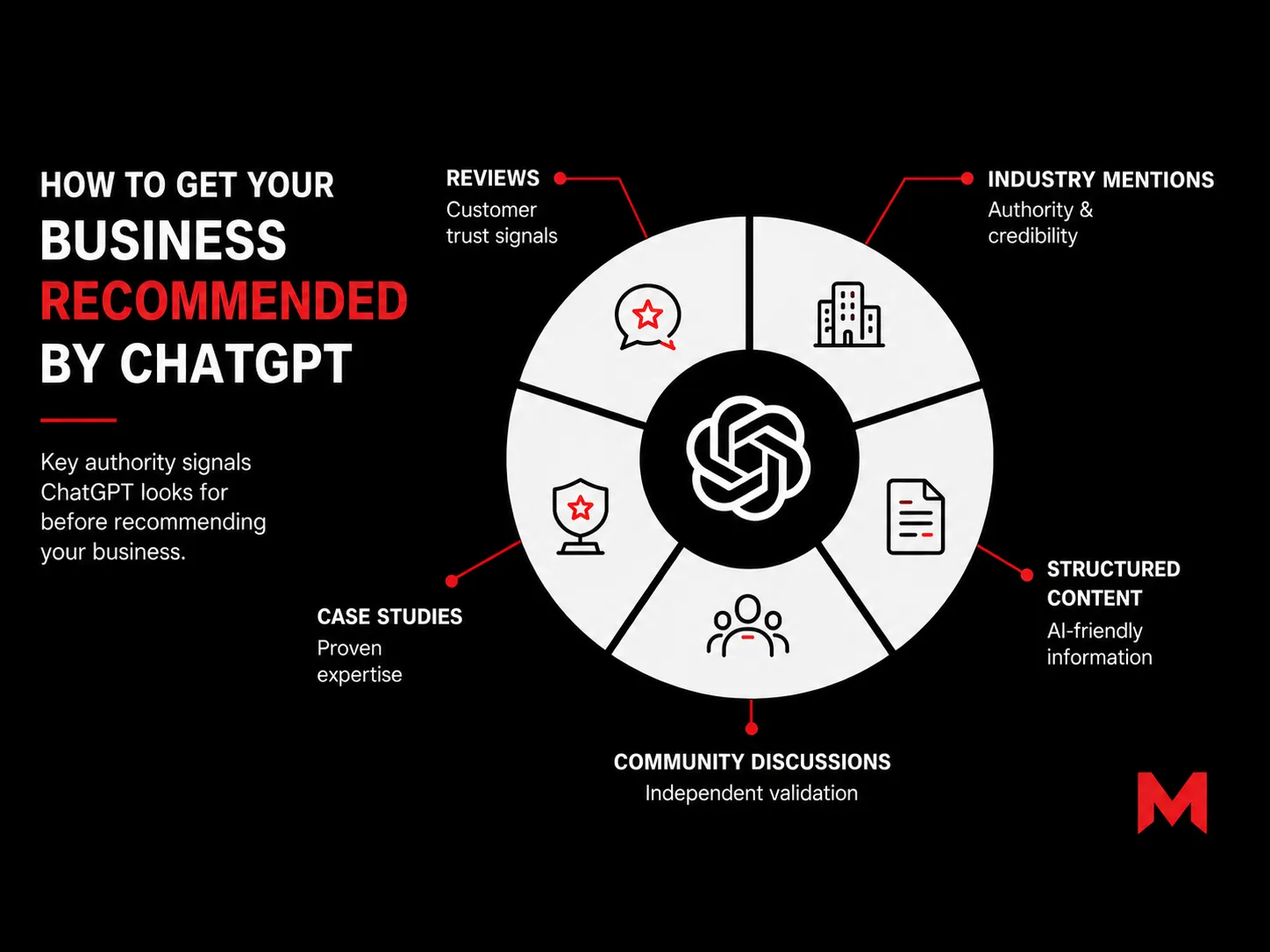
We are moving into an era where your reputation across the web is more important than the keywords on your page.
Take Flowergrid, a holistic wellness centre in Croydon. Instead of just saying “Flowergrid is good,” the brand builds authority through specialist practitioners, genuine patient reviews, and niche positioning in mind, body, and spirit wellbeing.
When you combine this level of authority with AI and automation tools, like the Luna AI therapy bot we developed for them, you create a brand that is not only “visible” but “citable.” ChatGPT recommends businesses that look like experts, and expertise is proven through consistent, high-quality data.
While organic recommendations are built through trust signals, there is now a secondary way to ensure visibility: ChatGPT Ads.
OpenAI has recently introduced the ChatGPT Ads Expansion UK, allowing brands to appear directly within high-intent conversations. This is a game-changer for businesses that want to bridge the gap while their organic authority is still building.
As this channel develops, insights from testing ads in ChatGPT show that these placements behave very differently to standard search ads. They are highly contextual and appear when a user is already asking deep, comparative questions.
For most brands, the best approach will be a combination of building long-term organic authority and knowing how to align Ads in ChatGPT and your marketing strategy to reach customers during these high-intent moments.
This ensures you are visible whether the user is looking for an “objective” recommendation or a direct solution.
If you want to move the needle on how to get your business recommended by ChatGPT, follow this 4-step framework:
Step 1
Where does your brand appear besides your website?
Step 2
Reviews are one of the strongest trust signals.
Step 3
Direct answers to the questions prospects ask AI.
Step 4
Help AI verify your location, services and details.
Where does your brand appear besides your website? If the answer is “nowhere,” build a consistent digital PR, guest posting, and citation strategy to expand your footprint.
Reviews are one of the strongest trust signals. Focus on collecting detailed, service-specific reviews on Google and relevant industry platforms.
Move beyond brochure-style copy. Create FAQ sections, direct-answer content, and pages that address the exact questions prospects ask AI assistants.
Use LocalBusiness and Service schema to help AI systems verify your location, service areas, offerings, and business details with confidence.
The goal of modern marketing is no longer just to rank on page one. The goal is to be the chosen answer.
If you are not sure where your brand stands in the era of AI search, or why you aren’t getting the recommendations you expect, we can help. We offer a free marketing audit that reviews your website structure, your search visibility, and your overall “discoverability” signals.
We will show you exactly what is helping your brand and what is making you invisible to AI search models.
Request your free audit here: Digital Marketing Agency in London.
Let’s make sure your business is the one the AI recommends.
Related guides: ChatGPT Ads in India: How Businesses Can Advertise on ChatGPT, ChatGPT Ads for B2B Companies: How to Reach Decision Makers.
ChatGPT recommends businesses based on trust signals and authority. To increase your chances, focus on building a strong digital footprint outside your own website. This includes earning mentions in industry publications, maintaining a high volume of positive third party reviews, and ensuring your website content is structured and easy for an AI to extract.
Traditional SEO focuses on ranking specific pages for specific keywords. In contrast, AI search is entity based. ChatGPT looks for a trustworthy business or solution to recommend within a conversation. While technical SEO still matters, AI prioritises reputation, third party validation, and how clearly you answer specific user problems.
No. Unlike traditional advertising where budget often dictates reach, organic AI recommendations are earned through clarity and credibility. Small businesses can outperform larger competitors by being the most specific, well reviewed, and citable authority in their particular niche or location.
With the recent expansion of the OpenAI advertising platform, businesses can now use ChatGPT ads to appear directly within relevant conversations. Unlike traditional search ads that rely on keywords, these ads are contextual and appear when a user is actively researching or comparing solutions, providing immediate discoverability while you build your organic authority.
Yes. AI models crawl local directories and map data to verify business details. Ensuring your name, address, and phone number are consistent across the web is vital. High quality reviews on your Google profile act as a significant trust signal that tells the AI your business is active and reliable.
AI models prefer structured, answer focused content. Adding FAQ sections, clear headings, and direct definitions of your services makes it easier for the AI to parse your information. Avoid vague marketing buzzwords and focus on providing citable facts and data points that prove your expertise.
Building brand authority is a long term process that typically takes three to six months. The more frequently your brand is mentioned on high authority external sites and reviewed by real customers, the faster AI models will begin to recognise you as a trustworthy entity worth recommending to users.
Want this handled for you every month? See our Care and Growth plans, start with the Starter plan, or see all our services. Curious who we are? Read about us and how we work.
Built to be quoted by AI. This page ships with the same structured data we set up for clients.

ChatGPT Ads for B2B companies can help brands reach decision makers during early research stages. Learn how they work, benefits, and strategy insights.

Testing ads in ChatGPT: discover how the OpenAI pilot works and the best ways to prepare your business. Here is what we know so far and what is still unclear.

Ads in ChatGPT are here. Discover what businesses need to know about OpenAI's advertising rollout and how to adapt your marketing strategy.

ChatGPT Ads in India are now available. Learn how ChatGPT advertising works, how to set up campaigns, costs, targeting and what businesses need to know.

OpenAI has launched ChatGPT ads in the UK. Discover what the ChatGPT ads expansion UK means for your business and how multi-advertiser placements work.
Understand how people search in ChatGPT compared to Google. Discover the 4 types of AI search behavior and learn how to optimize your brand for AI discoverability.
Type what you want to be found for. We'll come back with a real plan, not a sales pitch.