




How to Write Effective AI Prompts for Better Results
You ask an AI tool to write an email, analyse customer feedback, explain something to a customer or help with a business idea. The response looks fine, but it is not quite what you needed. It may be too general, use the wrong tone or leave out important details.
Often, the problem is not the AI tool. It is the instruction you gave it.
A good prompt gives AI enough information to understand the task and the result you are looking for. If you are new to AI prompting, our guide on what an AI prompt is and how to write a good one covers the basics. Once you understand what a prompt is, the next step is learning how to write effective AI prompts for real tasks.
What Makes an AI Prompt Effective?
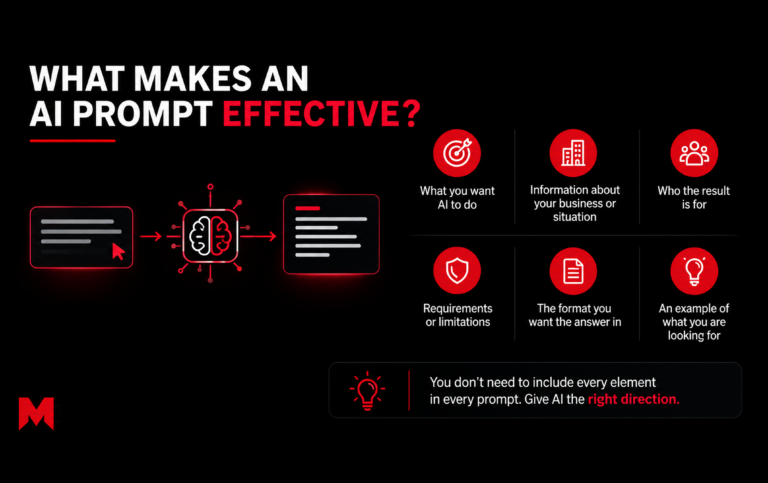
An effective prompt does not have to be long or complicated. It simply needs to give AI the information that matters.
Depending on the task, this might include:
- What you want AI to do
- Information about your business or situation
- Who the result is for
- Requirements or limitations
- The format you want the answer in
- An example of what you are looking for
You do not need to include every element in every prompt. The aim is to give AI enough direction to understand the job properly.
1. Start With a Clear Task
One of the easiest ways to improve a prompt is to be specific about what you want AI to do.
For example:
Less specific:
Help me with my website.
More specific:
Review the homepage text below and suggest three changes that could make our main service easier for first-time visitors to understand.
The first prompt gives AI a subject but not a clear job. The second tells it exactly what to do.
Think about the action you want. Do you want AI to write, summarise, compare, analyse, organise, explain or rewrite something?
Start there.
2. Give AI Context About Your Business and Audience
AI does not automatically know your business, your customers or the situation you are dealing with.
Suppose you ask:
Write a post about our new service.
You might know exactly what you mean, but AI does not know what the service is, who you sell it to or what makes it useful.
Instead, give it some context:
I run a small accountancy firm in Manchester. We mainly work with freelancers and small businesses. We have introduced a fixed monthly bookkeeping service. Write a short LinkedIn post explaining the service to existing clients who already use our accountancy services.
Now AI knows more about the business, the audience, the service and the purpose of the content.
The same principle applies to almost any business task. If the answer depends on information about your company, customers, products or situation, provide that information.
3. Set Clear Requirements
Once AI understands the task and context, tell it about any requirements that matter.
You might specify:
- The length
- The tone
- The language
- What to include
- What to leave out
- The number of ideas you need
- The level of detail
- Information it should use
For example:
Write a 250-word email for existing customers. Use British English and keep the tone friendly and professional. Avoid technical terms and finish with a clear next step for the customer.
These instructions give AI boundaries to work within.
However, more instructions do not automatically make a prompt better. Include the requirements that actually matter to the task.
4. Tell AI What You Want the Output to Look Like
Sometimes you know what information you need, but the format is just as important.
Instead of:
Analyse these customer reviews.
Try:
Analyse these customer reviews and identify the five most common complaints. Present the results in a table with the complaint, number of mentions, an example and a suggested action.
You can ask for:
- A table
- Bullet points
- A numbered list
- A short summary
- An email
- A step-by-step process
- Several options
- A comparison
Being clear about the final format can make the response easier to review and use.
5. Use Examples When You Need a Specific Result
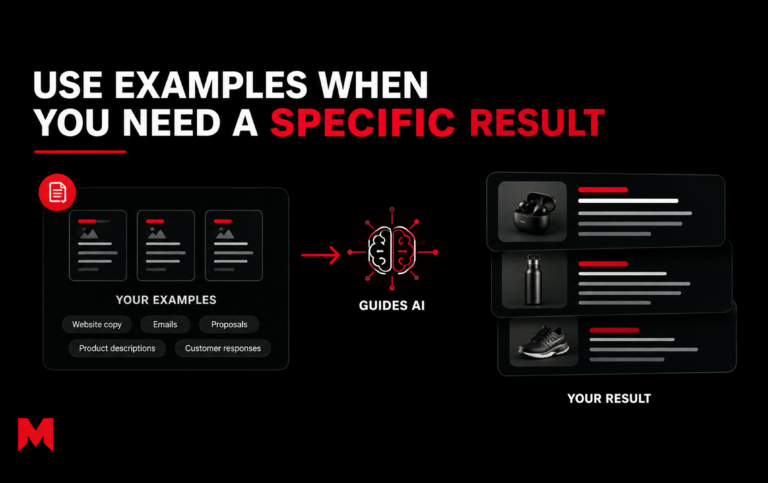
Sometimes it is difficult to explain exactly what you want with instructions alone. In those situations, an example can help.
For example, if you want AI to write product descriptions in the same style as your existing website, give it a few examples.
Here are three product descriptions from our website. Use them as a reference for tone, structure and level of detail. Now write a description for this new product.
Your examples could be previous emails, website copy, proposals, product descriptions or customer responses.
This is particularly useful when your business has an established way of communicating with customers.
6. Refine the Prompt After Seeing the Response
Writing effective AI prompts is not always a one-step process.
Your first response can show you what information was missing.
For example, you might start with:
Write a welcome email for our new customers.
The response may be too formal.
Instead of starting again, you can refine the instruction:
Rewrite this in a warmer, more conversational tone. Keep it under 150 words and make the next step for the customer clearer.
You can then make another adjustment if needed.
Think of prompting as a conversation. Give AI the task, review the response and explain what needs to change.
A Simple Before-and-After Example
Imagine you own a home cleaning company and want AI to help write an email promoting a new weekly cleaning service.
Basic prompt:
Write an email promoting my cleaning service.
There is very little information for AI to work with.
More effective prompt:
I run a residential cleaning company in Leeds. Our main customers are working couples and families. We have introduced a weekly home cleaning service with the same cleaner visiting each week. Write an email for existing customers introducing the service. Explain the benefit of having a regular cleaner and encourage readers to enquire about availability. Use British English, keep the tone friendly and professional, and keep the email under 200 words. Include a short subject line.
The second prompt gives AI the task, business context, audience, purpose, requirements and expected format.
That is the basic idea behind how to write effective AI prompts. You are not trying to find a special phrase that makes AI work better. You are giving it the information it needs to do the job.
Are ChatGPT Ads worth considering for Indian businesses?
It is too early to say that ChatGPT Ads will outperform established advertising channels for every business.
The platform is still developing, and businesses will need to test campaigns and compare their results with other channels.
However, the opportunity is worth watching. ChatGPT is increasingly being used for research, comparisons and decision-making, and OpenAI is now providing businesses with a way to participate in that environment through paid advertising.
For businesses considering ChatGPT Ads in India, the sensible approach is to start with a clearly defined audience, a specific offer, suitable creative and a landing page designed to convert. From there, campaign performance can determine whether the channel deserves a larger share of the advertising budget.
Common Mistakes to Avoid
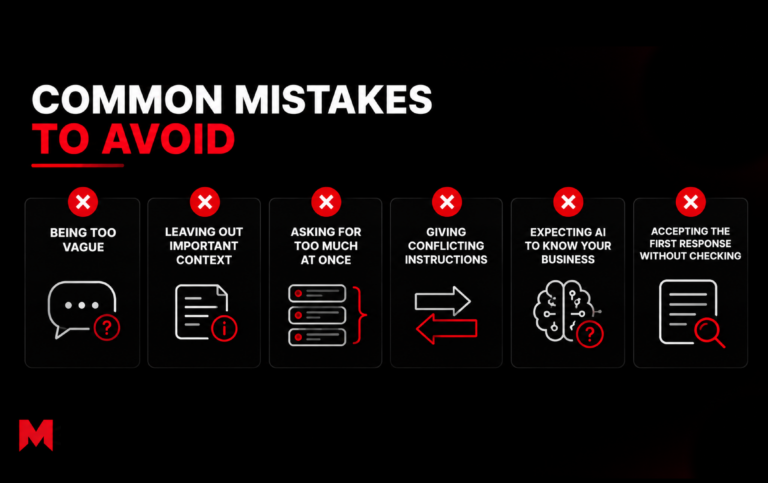
A few simple mistakes can make AI responses less useful.
Being too vague:
“Make this better” does not tell AI what better means.
Leaving out important context:
AI cannot reliably account for information you have not provided.
Asking for too much at once:
If a task involves several different jobs, breaking it into smaller steps can make the process easier to manage.
Giving conflicting instructions:
Make sure your requirements work together.
Expecting AI to know your business:
Unless you provide the relevant information, AI may fill gaps with assumptions.
Accepting the first response without checking it:
A well-written prompt does not guarantee that every fact or recommendation in the response is correct. Review important information before using it.
A Quick Checklist for Writing Effective AI Prompts
Before sending a prompt, ask yourself:
- Have I clearly explained what I want AI to do?
- Have I provided the relevant business or situation context?
- Have I explained who the result is for?
- Have I included important requirements or limitations?
- Have I explained what I want the final result to look like?
- Would an example help AI understand what I mean?
- Have I left anything important open to interpretation?
You do not need a long prompt every time. A simple task may only need one or two clear instructions. A more complicated task may need considerably more context.
The goal is not to write the longest prompt. It is to give AI the information it needs to produce a useful result.
Using AI Beyond Individual Prompts
Businesses can also connect AI with processes such as customer enquiries, lead qualification, appointment booking and customer support.
Maximus Mediascape helps businesses explore these applications through AI automation, chatbots and connected workflows, alongside its wider digital services.
The better you understand how to communicate a task to AI, the easier it becomes to use these tools for practical work. Start with the task, add the context that matters, set clear requirements and refine the result when necessary.
That is often all you need to write an effective AI prompt.
Frequently Asked Questions
An effective AI prompt clearly explains what you want AI to do and provides the relevant context, requirements and output format needed to produce a useful response.
Start with a clear task, provide relevant context, explain your requirements, specify the desired output and refine the prompt based on the response you receive.
Not necessarily. A good prompt does not have to be long. It should contain the information AI needs to understand the task without adding unnecessary details.
Depending on the task, you can include the goal, business or situation context, target audience, requirements, tone, limitations, output format and examples.
Context helps AI understand your specific situation. For example, information about your business, customers, products or goals can help produce a more relevant response.
Examples can be useful when you want a particular writing style, structure or type of response. You can provide previous emails, website copy, product descriptions or other relevant examples.
No. A well-written prompt can make a response more relevant and useful, but it does not guarantee that all information provided by AI is accurate. Important facts should always be checked before you use them.