Retention Stage of the Customer Journey: How to Turn First-Time Customers into Loyal Customers
Discover why the Retention Stage of the Customer Journey matters and explore practical ways to improve customer loyalty and encourage repeat customers.

By Maximus Mediascape
TLDR
Explore the stages of the customer journey and understand how customers discover, compare, decide and build lasting relationships with businesses.
Ask AI to summarise
Every customer starts somewhere.
They might discover your business through a Google search, a recommendation from a colleague or a social media post. They may visit your website more than once, compare your business with competitors and spend days or even weeks deciding whether to make a purchase.
The path from discovering your business to becoming a loyal customer is known as the customer journey.
Understanding this journey helps you see your business through your customers’ eyes. Instead of asking why people are not buying, you begin asking what information, reassurance or experience they need at each stage.
For business owners, this shift in perspective leads to better decisions. It helps you create useful content, improve your website, build trust and strengthen customer relationships over time.
In this guide, we’ll explore the four key stages of the customer journey, what customers are thinking at each point and how businesses can support them throughout the process.
The customer journey describes every interaction a person has with your business, from recognising a need to becoming a repeat customer.
It is not simply a sales funnel or a marketing process. It reflects how real people make decisions.
Some customers move through the journey quickly. Others spend weeks researching, comparing options and seeking reassurance before making a purchase. Many revisit previous stages before they are ready to commit.
Understanding these behaviours allows businesses to communicate more effectively instead of delivering the same message to every potential customer.
Many businesses focus heavily on attracting new customers.
While generating visibility is important, it is only one part of the journey.
Customers need different things depending on where they are in their decision-making process.
Someone who has just discovered your business is unlikely to respond to the same message as someone who is already comparing prices or looking for reassurance before making a purchase.
Understanding these differences helps businesses:
Different stages also benefit from different marketing activities. Educational content, search visibility, website experience, customer communication and ongoing engagement all play a role in supporting customers as they move through the journey.
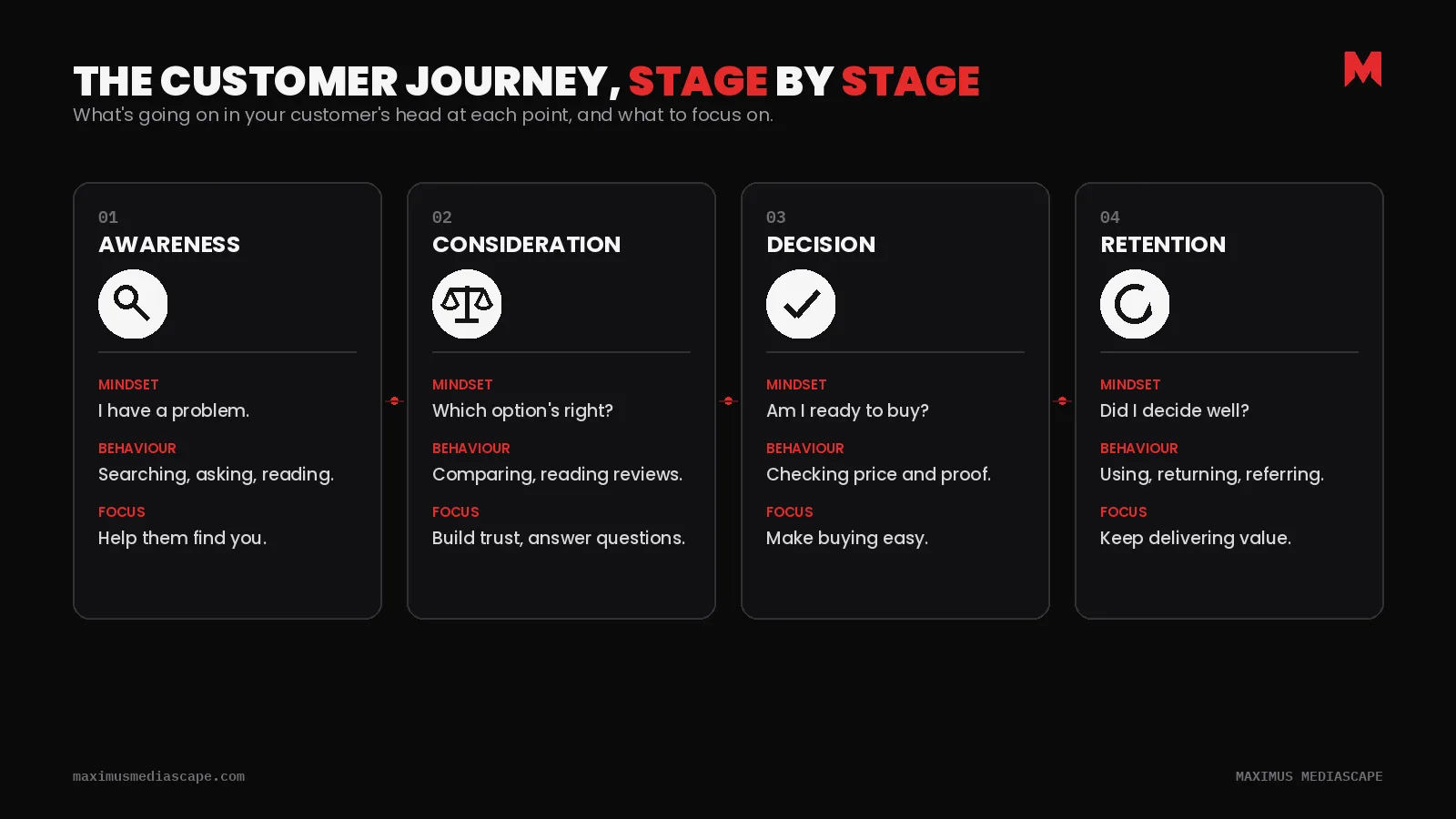
The customer journey can be divided into four main stages, with each stage representing a different mindset, behaviour and expectation.
At this stage, customers are recognising a problem or need. They are usually searching for information, asking for recommendations or exploring different sources to better understand their situation. The business focus here is to provide helpful information and make customers aware of possible solutions.
Once customers understand their problem, they begin comparing their options. They may explore different businesses, read reviews, visit websites and look for evidence they can trust. The focus during this stage is to build confidence, answer important questions and help customers understand what makes one option different from another.
After the purchase, customers decide whether their experience was valuable enough to continue the relationship. They may return, recommend the business or choose another provider in the future. The focus at this stage is delivering ongoing value, maintaining communication and building long-term customer relationships.
Every customer journey begins with awareness.
Rather than searching for a specific business, they are looking for information. They want to understand their problem, explore possible solutions and learn from trusted sources.
For example, someone searching for ways to improve their online visibility may read articles, watch videos or ask for recommendations before they ever think about contacting a digital marketing agency.
Businesses that consistently educate their audience are more likely to become part of that early research process.
Helpful resources during this stage often include:
The goal is not to sell immediately. It is to provide value and establish credibility before the customer begins comparing providers.
Once customers understand their problem, they begin evaluating different solutions.
Trust becomes increasingly important.
Customers look for evidence that a business understands their challenges and can deliver the results they are looking for.
During this stage, businesses should focus on answering questions clearly and reducing uncertainty.
Customers often look for:
A well-structured website also becomes increasingly important.
If customers struggle to find information, navigate your pages or understand your offering, they may continue their search elsewhere.
Towards the end of this stage, customers should feel informed rather than pressured.
The businesses that build confidence early often become the strongest contenders.
The decision stage is where customers make their final choice.
By this point they have usually narrowed their options to a small number of businesses.
Their remaining questions are often centred around confidence rather than information.
They may wonder:
Small details can influence purchasing decisions.
Clear calls to action, transparent communication, customer reviews, guarantees and responsive support all help customers feel more comfortable moving forward.
Some businesses also use live chat or AI-powered assistants to answer common questions quickly, helping customers get the reassurance they need without waiting for a response.
The aim is not to persuade customers through pressure but to remove unnecessary friction from the buying process.
The customer journey does not end after the purchase.
In many industries, retaining existing customers is more valuable than continually acquiring new ones.
After making a purchase, customers begin evaluating whether their expectations have been met.
They ask themselves:
Positive experiences encourage repeat business and referrals.
Negative experiences often result in customers quietly leaving without providing feedback.
Businesses can strengthen customer relationships by continuing to provide value after the sale.
Examples include:
Not always.
Some customers move through every stage in order, while others skip stages or revisit earlier ones before making a decision.
For example, a customer may:
Others may complete the entire journey within a single day.
Buying behaviour depends on factors such as the level of investment, the complexity of the product or service and the customer’s previous experience.
Rather than expecting every customer to follow the same path, businesses should focus on making each stage as helpful and accessible as possible.
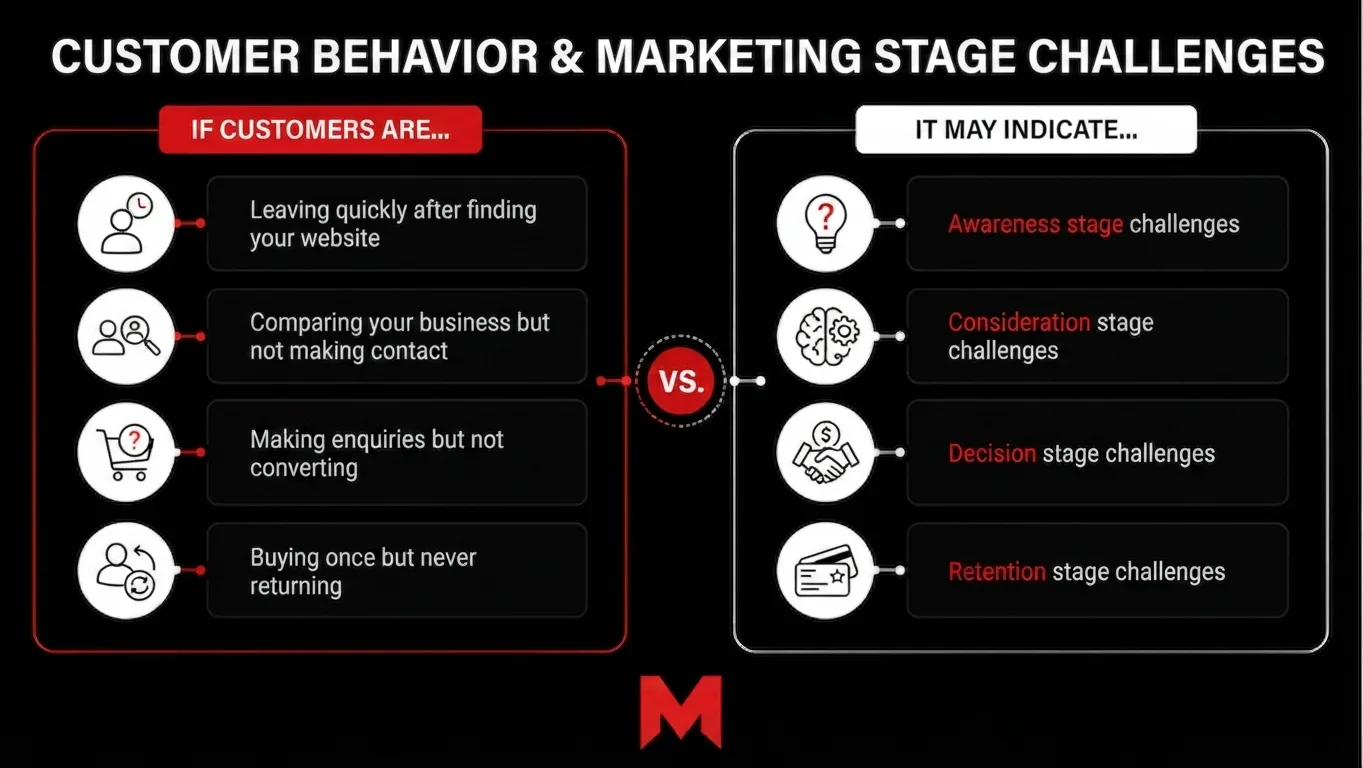
If customers regularly leave your website without enquiring, abandon purchases or fail to return after buying, there may be opportunities to improve your customer journey.
Ask yourself:
Answering these questions helps identify where improvements can have the greatest impact.
Every customer follows a journey before deciding to buy.
By understanding what customers are thinking, asking and expecting at each stage, businesses can create better experiences that build trust over time.
Rather than treating every visitor the same, consider what information or reassurance they need at that specific moment.
Small improvements at each stage can make the entire journey feel smoother, resulting in stronger relationships and better long-term outcomes for both your customers and your business.
Understanding the customer journey is the first step towards creating better customer experiences and making more informed marketing decisions.
If you’re unsure where your business is losing potential customers, our team can help you identify opportunities and recommend practical improvements.
The stages of the customer journey describe the different steps customers go through before, during and after making a purchase. The four main stages are Awareness, Consideration, Decision and Retention. Each stage reflects a different customer mindset, from discovering a need to becoming a loyal customer.
The stages of the customer journey help businesses understand what customers need at different points in the buying process. By recognising customer expectations, businesses can create more relevant content, improve customer experiences and address potential barriers before they affect purchasing decisions.
During the Awareness stage of the customer journey, customers recognise a problem, need or opportunity and begin searching for information. They may read articles, watch videos, ask for recommendations or explore possible solutions before deciding which businesses to consider.
The Consideration stage focuses on researching and comparing available options, while the Decision stage happens when customers are ready to choose a solution. During consideration, customers look for information and trust signals. During decision, they need reassurance that they are making the right choice.
Businesses can improve each stage of the customer journey by understanding customer needs, providing useful information, reducing friction and maintaining clear communication. This may include creating helpful content, improving website experiences, answering customer questions and staying connected after purchase.
No, the customer journey is different for every customer. Some people may move through the stages quickly, while others may spend more time researching, comparing options or returning to earlier stages before making a decision. Factors such as industry, purchase complexity and customer needs can influence the journey.
A customer journey focuses on the complete experience a customer has with a business, including research, purchase and post-purchase interactions. A sales funnel mainly focuses on moving potential customers towards a sale. The customer journey provides a broader view of customer behaviour and relationships.
Want this handled for you every month? See our Care and Growth plans, start with the Starter plan, or see all our services. Curious who we are? Read about us and how we work.
Built to be quoted by AI. This page ships with the same structured data we set up for clients.
Discover why the Retention Stage of the Customer Journey matters and explore practical ways to improve customer loyalty and encourage repeat customers.

Learn how the Decision Stage of the Customer Journey influences buying decisions and discover the key factors that help customers choose with confidence.

Learn what the Consideration Stage of the Customer Journey is, how customers compare solutions and what businesses can do to build trust and win more sales.

Learn what the Awareness Stage of the Customer Journey means and discover what every business should do before investing in digital marketing.
Learn what makes a brand actually memorable. Use the 5 Cs to improve clarity, consistency, credibility and brand recall, plus a free audit CTA.

Learn how to integrate social media into your digital marketing strategy to improve leads, SEO, and brand awareness. Get practical tips and a free marketing audit.
Type what you want to be found for. We'll come back with a real plan, not a sales pitch.