Retention Stage of the Customer Journey: How to Turn First-Time Customers into Loyal Customers
Discover why the Retention Stage of the Customer Journey matters and explore practical ways to improve customer loyalty and encourage repeat customers.

By Maximus Mediascape
TLDR
Learn what the Consideration Stage of the Customer Journey is, how customers compare solutions and what businesses can do to build trust and win more sales.
Ask AI to summarise
When people first realise they have a problem, they rarely make an immediate purchase. Instead, they spend time understanding their options, comparing businesses and deciding which solution is most likely to meet their needs. This period of research is known as the Consideration Stage of the Customer Journey.
For businesses, this stage is significant because it often determines whether a potential customer continues towards a purchase or chooses a competitor. The information people find during their research shapes their perception of a business long before they speak to a sales team or request a quote.
If you have already read our guide to the Awareness Stage, you’ll know that customers first recognise a problem before they begin searching for solutions. This article continues that journey by exploring what happens next, how customers behave during the consideration stage and what businesses can do to build confidence before a buying decision is made.
The Consideration Stage of the Customer Journey begins once a customer understands they have a problem or objective. Instead of asking, “What is wrong?”, they begin asking, “What is the best way to solve it?”
At this point, customers are not committed to a particular business or service. They are gathering information, comparing different approaches and narrowing their choices before making a final decision.
For example, imagine a business owner notices that their website receives plenty of visitors but very few enquiries. They may start researching possible solutions such as a website redesign, search engine optimisation, paid advertising, conversion rate optimisation or AI powered customer support. Rather than selecting the first company they find, they are likely to compare several providers, review their experience and assess which solution best fits their goals.
This stage is about evaluation. Customers are looking for evidence that a business understands their challenges and can provide an appropriate solution.
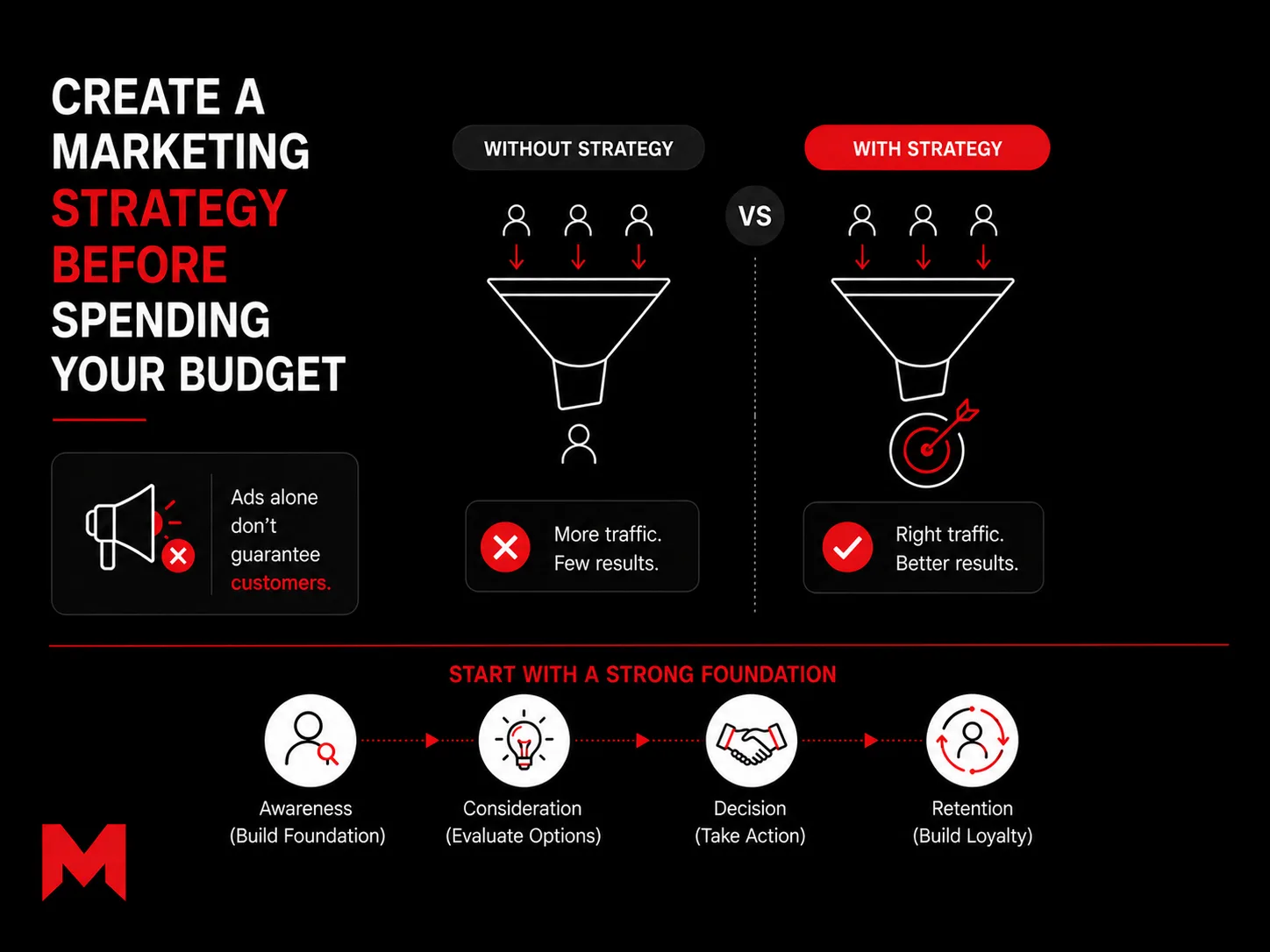
Every customer journey follows a series of stages, each with a different purpose.
The awareness stage begins when customers identify a problem or recognise an opportunity for improvement. Their priority is understanding what they are experiencing rather than choosing a product or service.
If you have not already read it, our guide to the Awareness Stage explains how businesses can attract potential customers before they begin comparing solutions.
During the consideration stage, customers actively evaluate their options. They compare businesses, services, pricing, expertise and previous work while deciding which providers deserve a place on their shortlist.
Their research often includes reading blog articles, exploring service pages, watching demonstrations and looking for customer reviews.
During the consideration stage, customers actively evaluate their options. They compare businesses, services, pricing, expertise and previous work while deciding which providers deserve a place on their shortlist.
Their research often includes reading blog articles, exploring service pages, watching demonstrations and looking for customer reviews.
Trust is one of the biggest deciding factors for customers during the awareness stage of the customer journey. Before contacting your business, people will often visit your website, read reviews and compare you with competitors.
Ask yourself a few simple questions.
Does your branding look professional?
Is your messaging consistent?
Can visitors quickly understand what your business does?
Does your website give them confidence to get in touch?
These are often the factors that influence a customer’s decision far more than a discount or promotional offer.
Our Website Design & Development, Website Redesign & Optimisation, and Brand & Identity services are designed to help businesses create a professional first impression that builds confidence from the moment someone lands on their website.
| Awareness Stage | Consideration Stage |
|---|---|
| Customer realises they have a problem. | Customer researches possible solutions. |
| The goal is to educate the customer about the problem. | The goal is to evaluate and compare different solutions. |
| Content typically includes blogs, educational articles, and introductory videos. | Content typically includes comparison guides, case studies, reviews, and product demonstrations. |
| The customer asks, “What’s wrong?” | The customer asks, “Which solution is right for me?” |
Once customers have gathered enough information, they move to the decision stage. They choose the business they believe offers the best solution and take the next step, whether that is requesting a proposal, booking a consultation or making a purchase.
The quality of information provided during the consideration stage often influences whether a business reaches this final stage.
Customers become much more deliberate during this phase of the buying journey. Their decisions are based on research rather than impulse.
Most customers explore several possible solutions before making contact with a business. They read industry blogs, search Google, watch videos, browse social media and seek recommendations from colleagues or friends.
Someone looking to improve their online presence may compare website redesigns with search engine optimisation, paid advertising or automation tools before deciding which approach is most appropriate.
This is why educational content is so valuable. Businesses that explain different options clearly are more likely to earn trust than those focused solely on promoting themselves.
Customers rarely compare prices in isolation.
Instead, they look at factors such as experience, previous projects, customer feedback, response times, technical expertise and the overall quality of communication.
A business with clear service information, transparent processes and relevant examples often creates a stronger impression than one that provides very little detail.
Customers want reassurance that a business has successfully solved similar problems before.
They often read testimonials, explore portfolios, review case studies and search for measurable outcomes. Evidence helps reduce uncertainty and makes it easier to compare different providers.
For example, if a company is considering a website redesign, they are likely to examine previous projects to understand the standard of work they can expect. If they are researching SEO or digital marketing, they may look for examples that demonstrate improved visibility, stronger engagement or increased enquiries.
As customers become more confident in their shortlist, their questions become more specific.
They may ask:
Businesses that answer these questions clearly help customers make informed decisions without unnecessary uncertainty.
The type of content customers look for changes once they enter the consideration stage. They are no longer trying to understand the problem. Instead, they want reliable information that helps them compare solutions and make a well informed decision.
Businesses that provide useful, transparent content are more likely to remain on a customer’s shortlist throughout this process.
Comparison articles help customers evaluate different products, services or approaches side by side. Rather than promoting a single option, they explain the strengths, limitations and ideal use cases for each.
For example, a business deciding how to improve its online presence might compare SEO with Google Ads or weigh the benefits of redesigning an existing website against building a new one. Articles like these allow customers to choose a solution that matches their goals instead of relying on assumptions.
A buyer’s guide brings together the information customers need before making a purchase. It explains what to look for, the questions to ask and the factors that should influence a decision.
For more complex services, a buyer’s guide can help customers understand topics such as project timelines, expected outcomes, pricing considerations and the level of support they should expect.
Case studies show how a business has solved similar challenges for previous clients. They provide context by explaining the problem, the solution that was implemented and the results that followed.
This type of content helps customers understand what a service looks like in practice and whether it is likely to meet their own requirements.
Product demonstrations give customers a closer look at how a product or service works before they commit.
Whether presented as a video, live presentation or interactive walkthrough, demonstrations help customers understand features, functionality and the overall user experience. They also answer practical questions that may not be covered in written content.
Webinars allow businesses to explore a topic in greater depth while giving customers the opportunity to learn directly from experienced professionals.
They are particularly useful for explaining more technical services, answering common questions and demonstrating expertise in a practical setting.
A well structured FAQ section addresses the questions customers are most likely to ask during the consideration stage.
Topics such as pricing, timelines, project processes, ongoing support and deliverables can often be answered before a customer even gets in touch. This reduces uncertainty and helps people move forward with greater confidence.
Independent reviews and professional opinions can carry significant weight during the decision making process.
Customers often seek third party perspectives to validate their own research. Positive reviews from respected industry professionals or trusted publications can strengthen credibility and provide additional reassurance.
Testimonials offer a direct insight into previous clients’ experiences.
Rather than focusing solely on results, effective testimonials explain how a business communicated, solved problems and supported the client throughout the project. This helps prospective customers understand what working with the business is actually like.
Whenever possible, giving customers the opportunity to experience a product or service before purchasing can reduce hesitation.
A free trial, interactive demo or consultation allows people to evaluate whether the solution meets their expectations before making a financial commitment.
Decision making guides simplify what can sometimes feel like an overwhelming process.
Checklists help customers compare providers using consistent criteria, such as experience, services, support, pricing transparency and previous work. They also encourage customers to focus on long term value rather than making decisions based solely on cost.
Together, these types of content help customers move through the consideration stage with greater confidence. Instead of relying on persuasive messaging alone, businesses can support informed decision making by providing practical resources that answer questions, explain options and make comparisons easier.
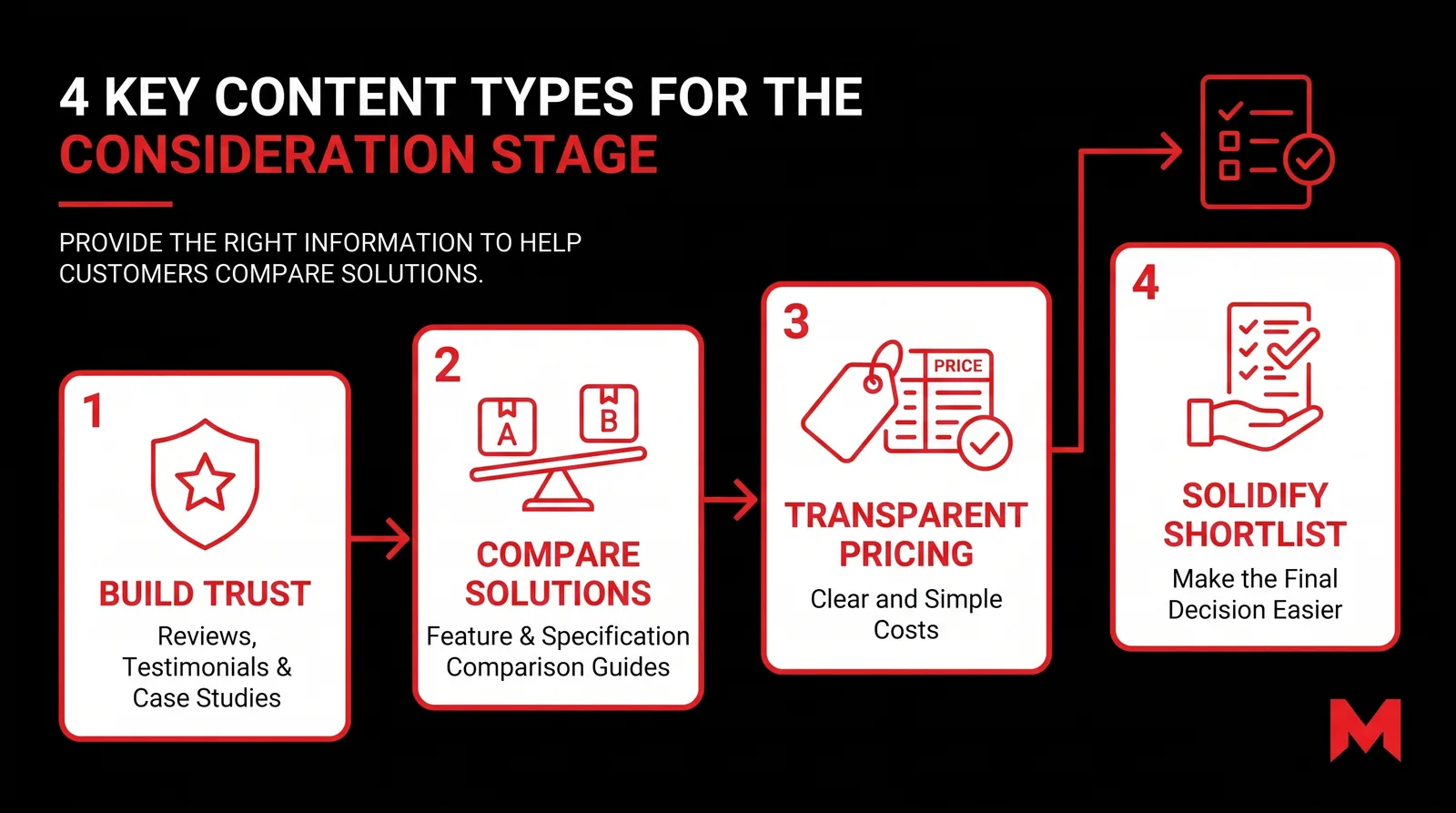
Customers are looking for confidence rather than persuasion.
Businesses can support this process by providing clear and practical information.
Some of the most effective approaches include:
Whether a business provides website development, search engine optimisation, paid advertising, branding or AI automation, clarity often has a greater impact than lengthy promotional messaging.
Many businesses lose potential customers without realising why.
One common mistake is focusing entirely on themselves rather than addressing the customer’s needs. Customers are interested in how a service solves their problem, not simply how long a business has existed.
Another mistake is providing too little information. If customers cannot understand what a service includes or how it works, they are likely to continue researching other providers.
Some businesses also overlook the importance of customer proof. Testimonials, portfolios and case studies provide valuable reassurance during the decision making process.
Finally, weak or outdated service pages can make comparison difficult. Customers should be able to understand a business’s expertise without needing to request basic information.
Imagine a growing company that wants to generate more enquiries through its website.
After recognising that their current website is underperforming, they begin researching possible solutions. They compare website redesign services, SEO strategies, Google Ads campaigns and AI chatbots that can improve customer engagement.
They read articles, review agency websites, compare portfolios and examine testimonials. They also look for businesses that explain their process clearly and demonstrate experience across multiple digital marketing services.
After narrowing their options, they contact the businesses that have provided the clearest information and the strongest evidence of previous work.
The final decision is not based on price alone. It is based on confidence.
The Consideration Stage of the Customer Journey is where customers decide which businesses deserve their attention.
Every blog article, service page, case study and testimonial contributes to that decision. Clear information helps customers compare their options with confidence, while incomplete or confusing content often encourages them to continue searching elsewhere.
Businesses that invest in educational content, transparent service information and a well organised website make it easier for potential customers to move towards a purchasing decision.
Whether someone is researching website design, SEO, digital marketing, AI automation or branding, they are looking for evidence that a business understands their objectives and can provide an appropriate solution.
By supporting customers during this stage instead of rushing them towards a sale, businesses are far more likely to build trust that lasts beyond the first enquiry.
The Consideration Stage of the Customer Journey is the phase where potential customers evaluate different products, services or businesses before making a purchase. They compare options, read reviews, explore case studies and research which solution best meets their needs.
During the consideration stage, customers actively research possible solutions to their problem. They compare businesses, read blog articles, explore service pages, watch demonstrations, review customer testimonials and look for evidence that a business can deliver the results they need.
The consideration stage is important because it influences whether a potential customer chooses your business or a competitor. Providing clear information, answering common questions and demonstrating expertise can help build trust before a purchasing decision is made.
Content that helps customers compare and evaluate their options performs best during this stage. This includes comparison articles, buyer’s guides, case studies, FAQs, customer testimonials, product demonstrations, webinars and decision making checklists.
In the awareness stage, customers recognise they have a problem or need but are not yet looking for a specific solution. During the consideration stage, they begin comparing different products, services and businesses to determine which option is most suitable.
Businesses can improve the customer experience by providing detailed service pages, publishing educational content, showcasing case studies, answering frequently asked questions and making it easy for customers to contact them for further information.
Customers typically look for pricing information, service details, case studies, customer reviews, testimonials, project timelines, business experience and evidence that a product or service can solve their specific problem. Clear and transparent information helps customers make informed decisions while narrowing down their options.
Want this handled for you every month? See our Care and Growth plans, start with the Starter plan, or see all our services. Curious who we are? Read about us and how we work.
Built to be quoted by AI. This page ships with the same structured data we set up for clients.
Discover why the Retention Stage of the Customer Journey matters and explore practical ways to improve customer loyalty and encourage repeat customers.

Learn what the Awareness Stage of the Customer Journey means and discover what every business should do before investing in digital marketing.

Explore the stages of the customer journey and understand how customers discover, compare, decide and build lasting relationships with businesses.

Learn how the Decision Stage of the Customer Journey influences buying decisions and discover the key factors that help customers choose with confidence.
Learn what makes a brand actually memorable. Use the 5 Cs to improve clarity, consistency, credibility and brand recall, plus a free audit CTA.

Learn how to integrate social media into your digital marketing strategy to improve leads, SEO, and brand awareness. Get practical tips and a free marketing audit.
Type what you want to be found for. We'll come back with a real plan, not a sales pitch.